Trackball, spinner, yoke or joystick on a retro arcade machine for the home
The control panel is the part of a retro arcade machine for the home you actually touch, and it decides whether the game feels like the arcade or like a toy.
Trackball — speed you set with your palm
A trackball has no top speed but yours. On Centipede the shooter crosses the mushroom field as fast as you can spin; on Missile Command you sweep between three silos in one movement. It needs elbow room and a surface that stays still, which is why we weight the base of our Centipede and Asteroids counter cabinets and sink the ball flush into the panel.
Spinner — two fingers, instant stop
A weighted knob that coasts and stops dead. Tempest lives on it: the claw runs the rim of the web at the speed of a flick, and a half turn back saves a life. Gravitar and Lunar Lander use the same control for rotation under thrust. It is the least space-hungry control we make, so the Tempest cabinet suits a narrow counter.
Yoke — both hands, aircraft feel
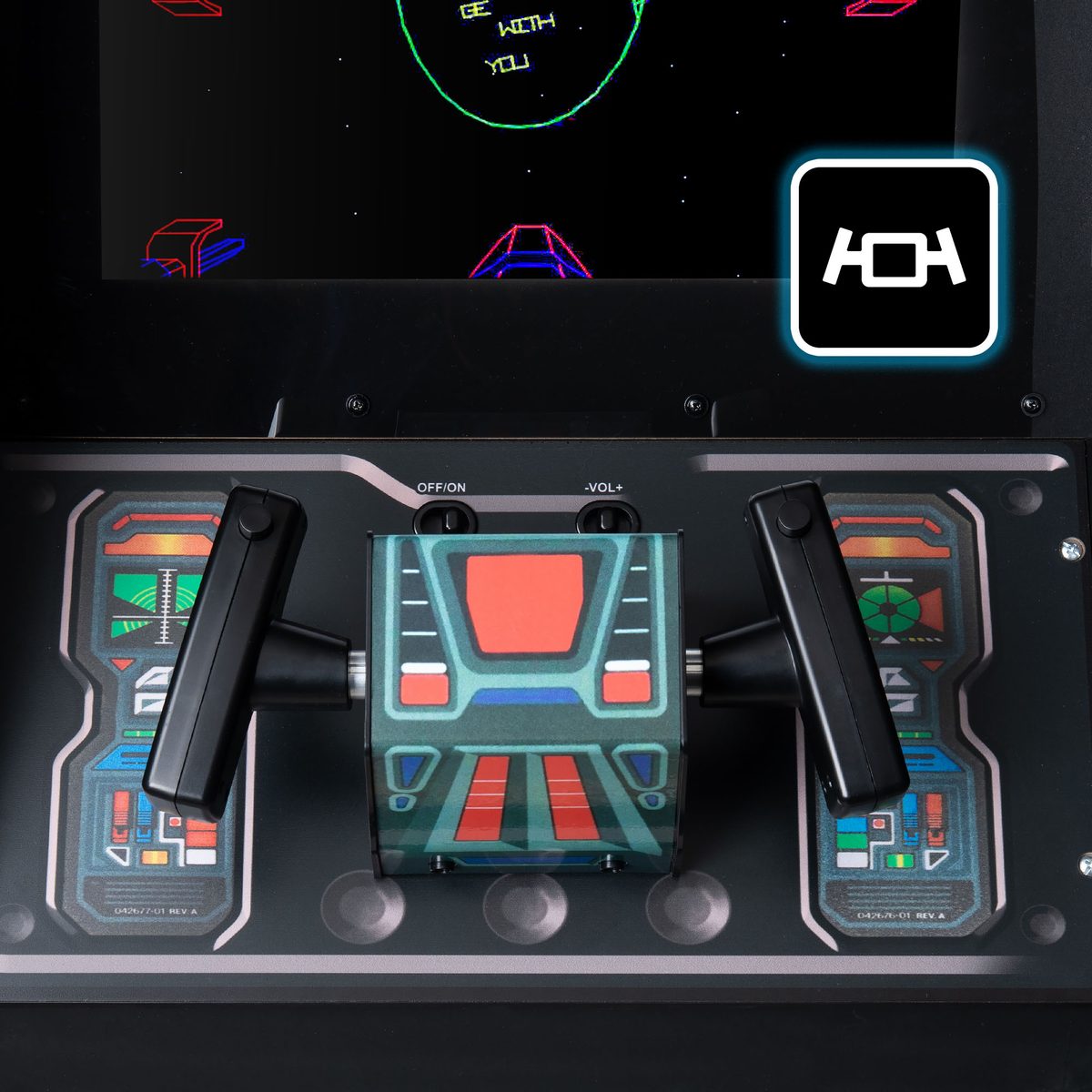
The Star Wars trilogy was written for a twin-grip yoke with thumb triggers, and it does not translate to a stick. Pull back and the crosshair climbs; push and you dive into the trench. Allow a step of clear floor so the full travel is available, or you will be fighting a wall as well as the Empire.
Joystick — the control that teaches corners
A microswitch stick gives one clean step per push and a click you can feel. Pac-Man, Ms. Pac-Man, Dig Dug, Galaga, Tetris and the WWE roster all run on it. The click matters more than it sounds: a maze corner cut on the right frame is the difference between a power pellet and a ghost, and a membrane pad hides that timing from you.
Matching control to player
Buying for somebody with no arcade history? A joystick cabinet is the gentlest start. Buying for a player who had a high score in 1984? The trackball and spinner cabinets are the ones that will surprise them, because almost nothing modern ships with either.
Why the control decides the retro arcade machine for the home you want
An arcade game is a board plus a control, and swapping the control makes it a different game. Centipede on a joystick is playable and wrong; the trackball is what lets you reverse a sweep in a single flick. Tempest on a stick loses the whole spin. Star Wars without a yoke loses the climb. We fit the control the original board was written for, which is why our panels are not interchangeable and why the title you want should decide the cabinet you buy.
Trackball
A heavy ball sunk flush in the panel, read in two axes with no centre position to fight. It is the authentic control for Centipede, Millipede, Missile Command and Crystal Castles, and it is why those machines need a base that will not slide across a counter. The modern versions in our Counter Series use a weighted shell for exactly that reason. Nothing else gives you that much fine action in a space the size of a hand.
Spinner, yoke and stick
A spinner is a free-running dial: one finger, no limit, perfect for Tempest and Warlords. A flight yoke is a two-handed grip that pulls and pushes with the triggers under the thumbs, built for the Star Wars trilogy. A microswitch joystick is the general-purpose arcade control, four or eight directions with an audible click, and it is what Pac-Man, Galaga, Dig Dug and the WWE titles were designed around. Each one has a feel you can recognise blindfolded.
How to choose without playing first
Pick the game you want to play most and let it choose the panel. If the answer is maze games, you want a stick. If it is Centipede or Missile Command, hold out for a trackball. If it is the Star Wars boards, nothing but the yoke will do. If the honest answer is variety, a counter machine with five Atari titles on one control gives you the broadest collection for the money, and the trackball models deliver the widest spread of classic arcade games per cabinet.
Why the control decides the machine
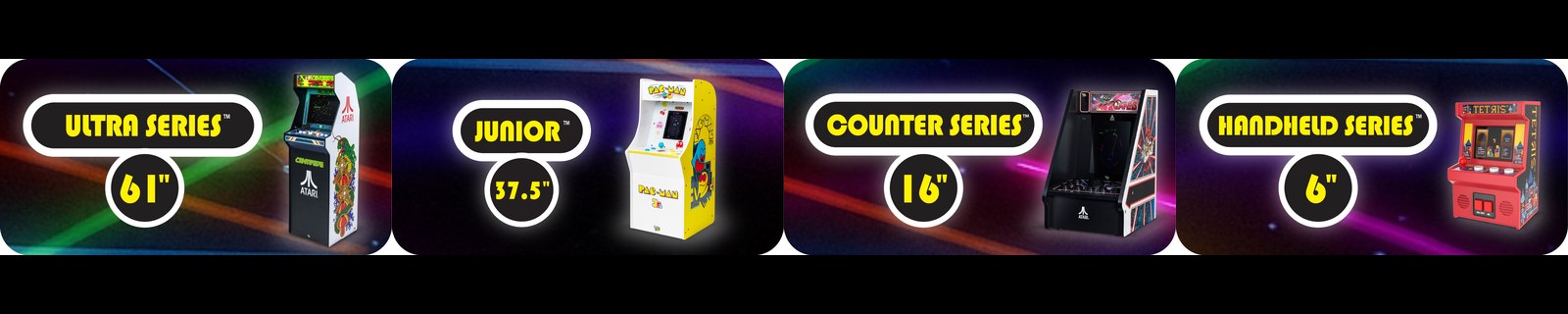
On a retro arcade machine for the home the control is the only part you actually touch, so it is the part worth being fussy about. A trackball spins, a spinner has weight and inertia, a yoke pulls back with two hands and a joystick clicks into a gate: four different kinds of action, and every original arcade game was designed around exactly one of them. Our cabinets are built with authentic arcade parts at every height, from the 6-inch mini machines to the 61-inch premium floor builds, because a licensed board on a cheap control is a worse product than no product. We keep the collection small and fixed — no custom panels, no pinball — and that is how the quality stays level across every size and every edition. If you only check one thing before ordering, check what your hands will be holding.
Matching a control to a room and a player
Combining controls is what turns two machines into a game room. A trackball machine and a joystick machine side by side feel like an arcade; two joystick machines feel like a shelf. Trackballs suit the high-variety Atari titles and reward a player who wants something physical. Spinners are the specialist choice and deliver the tightest excitement of the four. Yokes exist for one reason and that reason is a cockpit. Sticks are the modern default and the right call for a kid, a bedroom and anything that has to be durable without supervision. None of our machines need coin-operation, so a control can be learned over thousands of free turns rather than quarters, and that is the single biggest difference between the fun at home and the memory of the arcade. Explore the aisles by control rather than by character on the side art and you will choose better.